
Filing taxes in a foreign country is intimidating—especially in France, where “administrative complexity” is practically a national sport. But don’t panic! I’m here to help you prepare so you won’t have to scramble at the last minute.
Believe me, I get it. The French tax administration actually understands that we can make mistakes. In fact, I just had to inform them of an error I made in my own declaration last year, which I only caught while preparing this post!😅 If I can fix mine, you can certainly handle yours.
Here is a simplified breakdown of everything you need to know to stay compliant and avoid hefty fines.
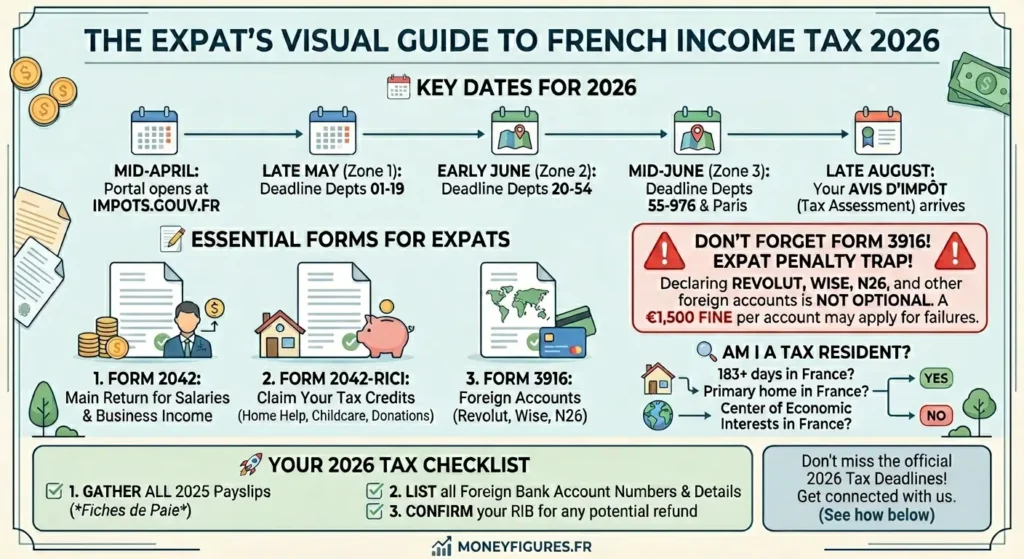
Note: The French tax administration typically releases the finalized 2026 calendar in early April. I will update this guide the moment the official ‘Brochure Pratique’ is published. Save this page to stay updated!
Who needs to file?
In 2026, you must declare the income you earned in 2025, provided you lived in France during that year.
📅 Key Deadlines for 2026 (Mark Your Calendar!)
In France, tax deadlines depend on where you live (your Département) and whether you file online (which is now mandatory for almost everyone).
- Mid-April 2026: The online declaration portal (impots.gouv.fr) officially opens.
- Late May 2026 (Zone 1): Deadline for Departments 01 to 19.
- Early June 2026 (Zone 2): Deadline for Departments 20 to 54.
- Mid-June 2026 (Zone 3): Deadline for Departments 55 to 976 (including Paris).
- Late August 2026: You receive your Avis d’Impôt (Tax Assessment).
💡 Alex’s Tip: If this is your first time filing and you don’t have an online login yet, you might need to file a paper return earlier (usually by mid-May). Don’t wait—get your tax number (Numéro Fiscal) as soon as possible!
📝 Essential Forms for Expats
The French tax system uses a “Main Form + Attachments” structure. Here are the big ones we expats need to watch out for:
- Form 2042: The main tax return for your general income (salary, freelance earnings).
- Form 2042-RICI: Where you claim tax credits (e.g., hiring a nanny, home cleaning services, or donations).
- Form 3916:The “Expat Must-Have.” You must declare every foreign bank account (Revolut, Wise, N26, etc.) held outside of France.
- ⚠️ Warning: Failure to do this can result in a €1,500 fine per account!
🔍 Am I a “Tax Resident” in France?
You are generally considered a French tax resident if you meet any of these criteria:
- Your primary home (foyer) is in France.
- You spend more than 183 days a year in France.
- Your primary professional activity or “center of economic interests” is in France.
💰 How to Lower Your Tax Bill (The Smart Way)
Before you hit “Submit,” check if you can reduce your taxable income.
- Invest in a PER (Pension Savings Plan): Contributions are often deductible from your taxable income. [Check back soon for my top-rated PER provider reviews]
- Assurance Vie: A specialized investment account with significant tax benefits after 8 years. [View my Comparison Table of Expat-Friendly Investment Platforms – Coming soon!]
- Employment Expenses: If you work from home, some of your professional costs might be deductible.
🚀 Pro-Expat Checklist for 2026
- Gather your “Fiches de Paie”: Collect all your 2025 payslips.
- List Foreign Accounts: Open your apps (Revolut, Wise) and note down the account numbers and opening dates.
- Check your RIB: Ensure the tax office has your current bank details for any potential refunds.
Still feeling overwhelmed? 🫠
If your situation is extra tricky—like having rental income from back home or complex stock options—don’t risk it. I always suggest talking to a pro for the heavy lifting. Better safe than sorry!