

If you are a salaried employee in France, you’ve likely seen “Prélèvement à la source” (withholding tax) deducted from your payslip every month. It feels like your tax obligations are handled automatically by your employer.
So, why does everyone start panicking when the Déclaration de Revenus season arrives between April and June? Here is why this annual ritual is mandatory, and how it protects you from massive fines.
1. What is the Déclaration de Revenus?
In France, the Déclaration de Revenus (Annual Income Tax Declaration) is not just a formality. It is the final reconciliation between what you’ve already paid throughout the year and what you actually owe.
The monthly deduction from your salary is only an estimate. The spring declaration is the only time the French Tax Authority (DGFiP) looks at your entire global financial picture to finalize your tax bill.
2. The “Hidden” Global Assets: Bank, Brokerage, and Crypto Accounts
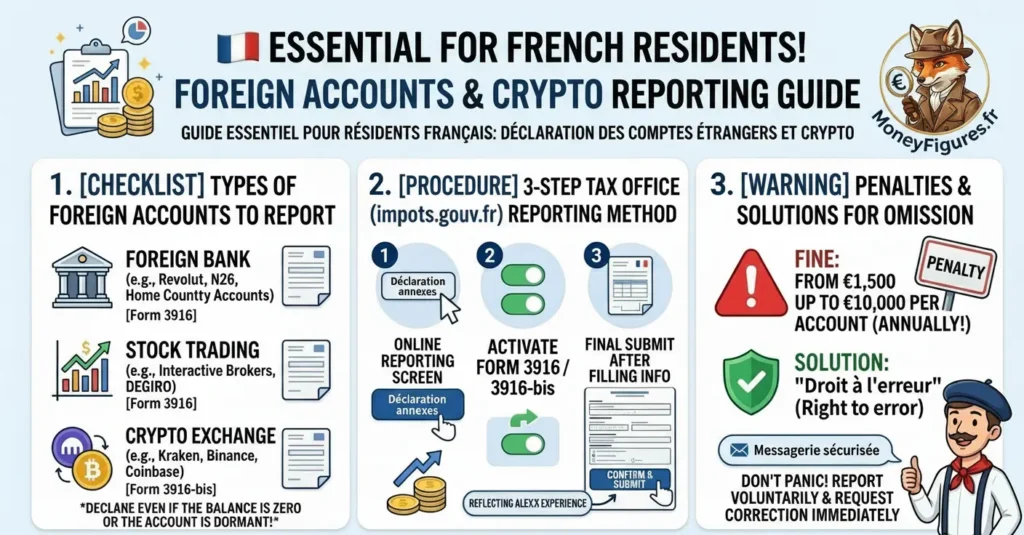
Your employer only reports your French salary. They do not report your global assets. You must manually disclose the existence of any accounts held outside of France, including:
- Foreign Bank Accounts (Form 3916): Savings or checking accounts in your home country.
- Foreign Stock Brokerage Accounts (Form 3916): Platforms like Robinhood, Charles Schwab, or Interactive Brokers.
- Foreign Digital Asset Accounts (Form 3916-bis): Crypto exchanges like Kraken, Binance, or Coinbase.
The Rule: You must declare these even if they are dormant or have a zero balance. The Penalty: Missing just one account can lead to a fine of €1,500 per year.
3. The “Right to Error” (Droit à l’erreur)
If you moved to France recently and forgot to declare an account in your previous filing, don’t panic. France has a legal principle called “Droit à l’erreur” (Right to Error).
If you proactively contact the tax office via your Messagerie Sécurisée on impots.gouv.fr to rectify an honest mistake, they are typically lenient. Self-reporting is your best defense against penalties.
4. Why You Might Actually Get Money Back
The April-June declaration window is also your only opportunity to lower your tax bill. You can claim credits for:
- Professional Expenses: Commuting or home office costs.
- Household Services: Cleaning, childcare, or gardening (CESU).
- Charitable Donations: Contributions to eligible organizations.
5. Your “Avis d’Impôt”: The Golden Ticket
Finally, your declaration results in an Avis d’Impôt (Tax Assessment). You cannot renew a Titre de Séjour, apply for a French Mortgage, or sign a Rental Lease without this document.
Summary: The Spring Checklist
- Window: April to early June.
- Form 2042: Main income.
- Form 3916 / 3916-bis: All overseas bank, stock, and crypto accounts.